There’s a version of my childhood I’ll never get back. Not because it slipped away in the natural progression of growing up, but because I never really got to live it in the first place.
When I look back on those pivotal years—those early teenage seasons that shape most people in subtle, formative ways—I see a very different kind of shaping. I wasn’t formed by freedom or innocence or the awkward joy of discovery. I was shaped by the absence of those things. I was shaped by instability, by watching two people who were supposed to be my anchors struggle just to stay afloat in their own lives. My parents weren’t ready for the reality of being adults—let alone parents—and the weight of that fell onto my shoulders far too early.
At an age when I should’ve been learning who I was through play and curiosity, I was learning how to emotionally regulate the adults around me. How to take up less space. How to manage other people’s chaos just to survive inside of it. I became wise beyond my years not by choice, but by necessity. Because there was no other way to make sense of a world where the grown-ups couldn’t be trusted to show up.
Eventually, I ran out of places to land. And when that happened—when I was out of options, out of parents, out of childhood—I ended up at my grandparents’ house.
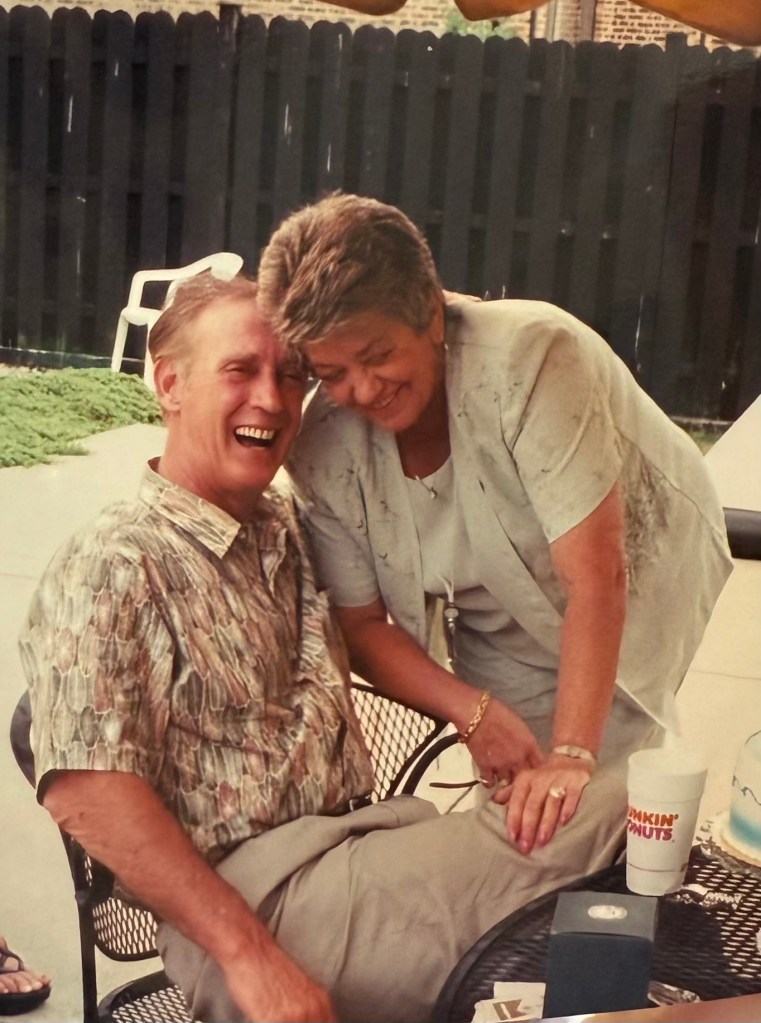
My Gram and Papa didn’t have to take me in, but they did. And in doing so, they gave me something I didn’t even know I needed: safety. It wasn’t perfect. It wasn’t soft and easy the way childhood should be. But it was safe. It was steady. It was a home.
Living there wasn’t like staying with grandparents in the way other kids did—where they’d be spoiled for the weekend, then handed back to their parents. I was a kid who stayed. A kid with invisible wounds. I became part of their day-to-day, part of their world—and that changed everything.
Gram was hard on me. Really hard. She wasn’t easily impressed. If I got a B, it needed to be an A. There was no celebration for almost. No points for “trying your best.” It was, “You’re smart. Do better.” At the time, I thought it meant I wasn’t enough, that I was failing some invisible test I didn’t know I was taking. But now I see it more clearly: she expected more from me because she believed I could give more. Her high standards weren’t about perfection—they were about preparation.
She was relentless in her expectations because she had to be. There was no room for me to coast or fall behind or act helpless. I wasn’t allowed to be a fragile kid because my life hadn’t given me that luxury. And Gram saw that. She didn’t coddle me because she knew the world wouldn’t either. So she taught me grit.
Real grit. The kind that roots itself into your spine and carries you when no one else will. She taught me how to work through things—not just emotionally, but practically. I helped her clean the house top to bottom. I brought in the groceries, learned to fold towels the right way, ran the vacuum, cleaned dishes until they shined. I had responsibilities, and they weren’t optional. And at the time, I didn’t realize that what she was doing wasn’t about being hard on me—it was about building me. About making sure I knew how to stand on my own two feet.
There was no coddling. But there was consistency. There was structure. There was presence. She was there. Every day. Holding the line.
And yet—there were these beautiful cracks in her armor where her love would sneak through. The softness showed up in the small rituals. Like watching Survivor with her every week. I remember how she’d sit on the couch, arms crossed, locked into the screen—and I’d curl up near her, feeling like that time together was sacred, even if we weren’t saying much. Or when we went grocery shopping, and without fail, she’d grab a box of Hostess powdered sugar donuts just for me. She never forgot. That was her love: small, deliberate, remembered.
Papa was the more overtly gentle one. He’d sit with me while I did homework, make little jokes, pat my head and tell me he was proud. He’d ask me questions like I mattered. He never made me feel like a burden. Even though, deep down, I worried I was one all the time. He was patient, and kind, and made sure I knew I belonged.
They weren’t perfect. They were tired, older, probably overwhelmed. But they tried. They tried so hard to give me something close to normal when nothing about my life had been. They didn’t sign up for raising another child, but they did it anyway—with every bit of energy, structure, and love they had.
And it wasn’t until after they both passed that I could fully grasp what they gave me. The weight of their love hit me in hindsight, in waves of memory and grief. They didn’t love me the way I wished to be loved at the time—they loved me the only way they knew how. With structure. With expectation. With protection. With powdered sugar donuts and the warmth of a television glow.
Now, as an adult, I can say something I couldn’t then: I get it. I understand what they were trying to do. They weren’t just raising me—they were fortifying me. They were giving me grit when everything else in my life threatened to make me fragile.
And I’m someone now who would protect that 12-year-old version of me. Fiercely. I would have scooped her up and said, “You don’t have to try so hard. You don’t have to carry all of this.” I would’ve fought for her in the ways no one fought for me back then. I would’ve let her be soft. Let her be a kid. Let her rest.
But she didn’t get that. She had to grow up fast. She had to figure it out alone in a lot of ways. And still—she made it. She became me.
So much of who I am now is because of what I survived then. The grit that Gram drilled into me. The pride Papa placed in me like a seed. The structure. The discipline. The determination. The quiet knowing that even if I didn’t come from easy, I came from strong.
I carry grief, yes. But I carry gratitude too. Because now I know: I was never unloved. I was just loved in a language that took me years to translate. And now that I understand it, I carry it with me everywhere I go.
 the unlearn lab blog
Leave a comment