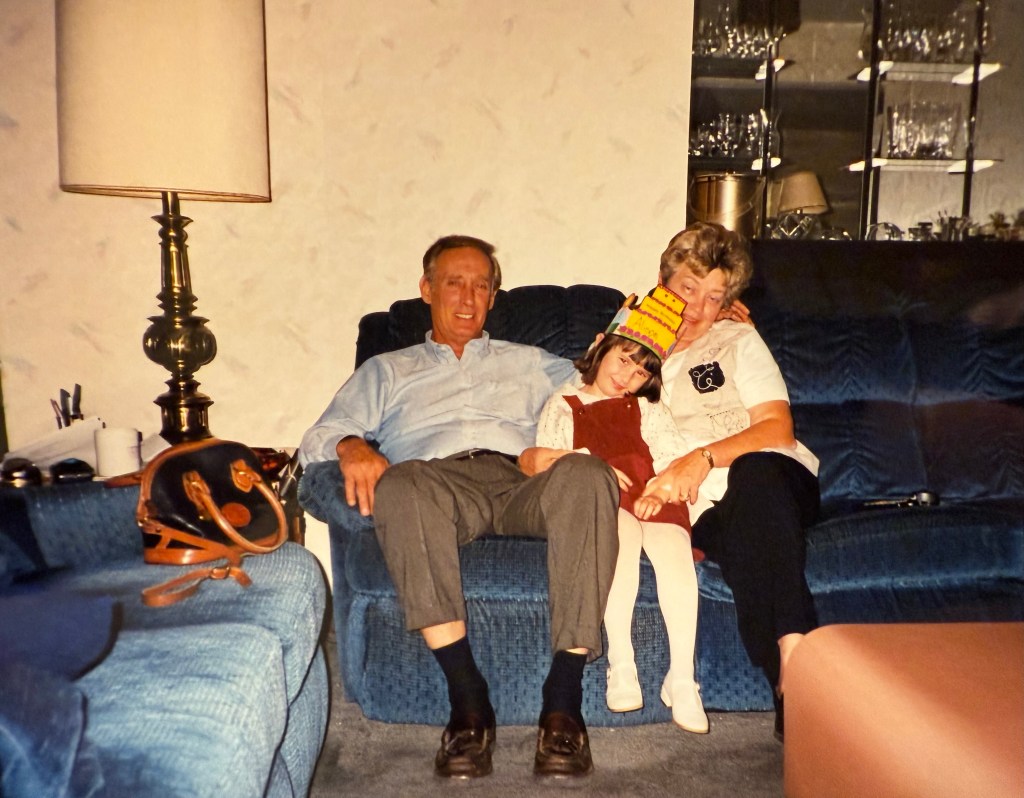
My grandpa passed earlier this year, and when I went home last week, my aunt handed me a box of keepsakes and pictures. Inside was a single photograph that stopped me cold—one I’d never seen before. It was my birthday. I must’ve been five or six, sitting on my grandparents’ laps, my hair a little messy, birthday crown on my head, my cheeks round, my smile cheesy. The kind of smile that takes up your whole face before life teaches you to shrink it down.
I’ve spent the last two and a half years of my adult life writing about my childhood, sifting through the memories like pieces of evidence—trying to understand where certain wounds came from, why I am the way I am. My journals are full of reflections about growing up too fast, being the “easy” one, the “mature” one, the emotional translator in a house where adults didn’t always act like adults. I’ve written about the quiet ache of feeling unseen, the confusion of loving people who didn’t always know how to love back, and the way that turned into a lifelong habit of overextending myself just to feel safe.
And yet—there, in that photograph, was proof that there were also moments of light. My grandparents’ arms wrapped around me, holding me steady, the warmth of love so simple it almost startled me to see it again. I didn’t have to earn it in that picture. I wasn’t mediating anyone’s emotions or performing for approval. I was just being. Happy. Whole.
Looking at that photo now, I realize how much I’ve defined my past by its fractures—by the absence, the instability, the things that hurt. I’ve spent so much time fighting that version of my story, trying to rewrite it into something neater, something I could control. But the truth is, there’s no editing the past into perfection. There’s only learning to hold it with compassion.
Peace, I’ve learned, isn’t a feeling that arrives once you’ve “healed enough.” It’s what happens when you stop fighting the past—when you stop waging war with the younger versions of yourself for not knowing what you couldn’t have known. It’s when you look at that smiling little girl and realize she didn’t need to be fixed—she just needed to be understood.
There’s something humbling about realizing that both things can be true: my childhood was heavy, and it had moments of joy. My parents were flawed, and they loved me in the best ways they knew how. I was a child who carried too much, and I was a child who laughed loudly, who found comfort in small things, who learned how to survive.
For so long, I believed peace meant closing the book on my past—getting over it, moving forward, being “better.” But now I see it differently. Peace is sitting cross-legged with that little girl from the photograph and letting her talk. It’s telling her she did enough. It’s thanking her for surviving, for feeling everything so deeply, for carrying me this far.
That one picture—just a small, slightly faded snapshot—feels like an anchor now. Proof that joy existed, even then. Proof that I came from love, even if it was complicated. Proof that the story isn’t just about what went wrong, but also about what endured.
Maybe peace isn’t a destination after all. Maybe it’s just the quiet moment when you finally stop running from your own reflection—when you can look back at your past, see all of it, and whisper, thank you.
Because the truth is, that little girl smiling on her grandparents’ laps was never lost. She’s been here the whole time, waiting for me to stop fighting the past long enough to see her again.
 the unlearn lab blog
Leave a comment